


January prices in June? Summer spikes in the GB power market
June 24, 2026


Previous Article
Next Article
Power markets in Northern Europe are traditionally winter-peaking: grids are most strained during winter due to high heating demand. That changed this week: a European heat wave sent the European electricity system into overdrive and sent prices spiking.
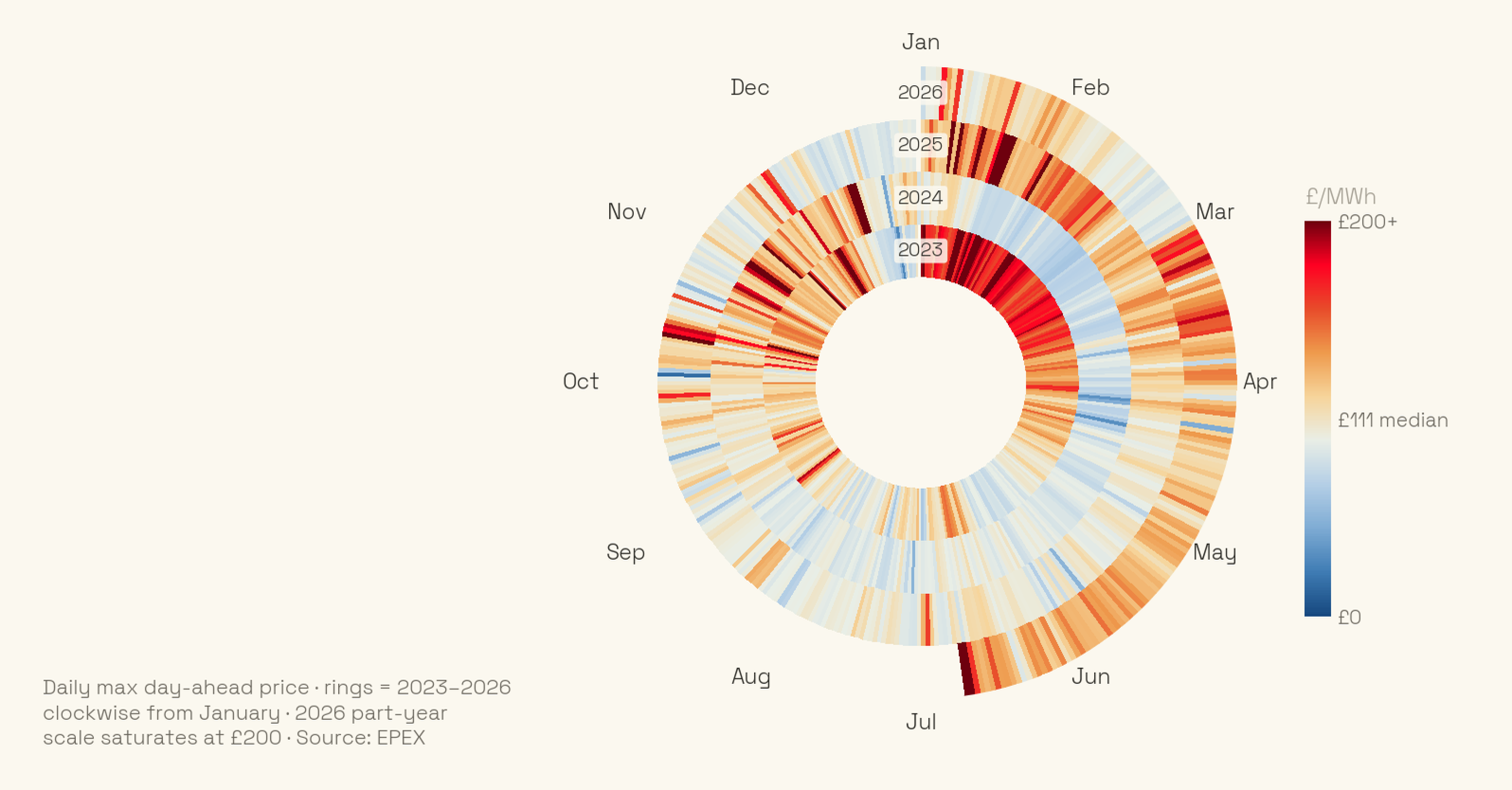
On June 24th even GB, where air conditioning is still regarded with suspicion, saw power prices surge to their highest price in 18 months. The UK hasn’t seen a peak price outside of December or January since September 20211, when the first gas crisis began.
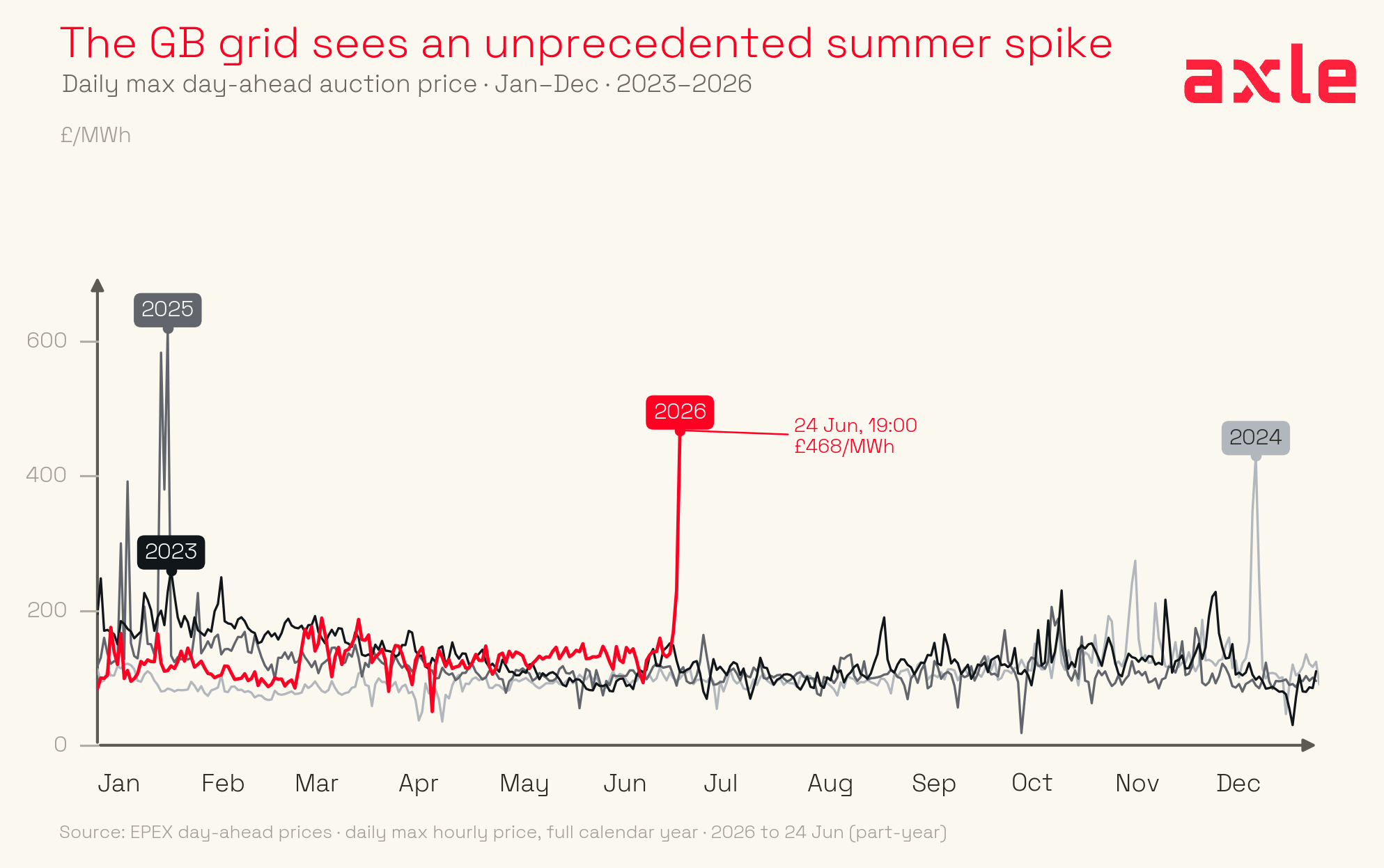
So what's the story? Supply is unusually tight and inelastic; under marginal pricing, even a small, unexpected demand bump clears at a punishing price. June 24’s high prices are driven by a handful of factors which emphasize the growing complexity and interdependency of the European grid.
Demand is higher than expected
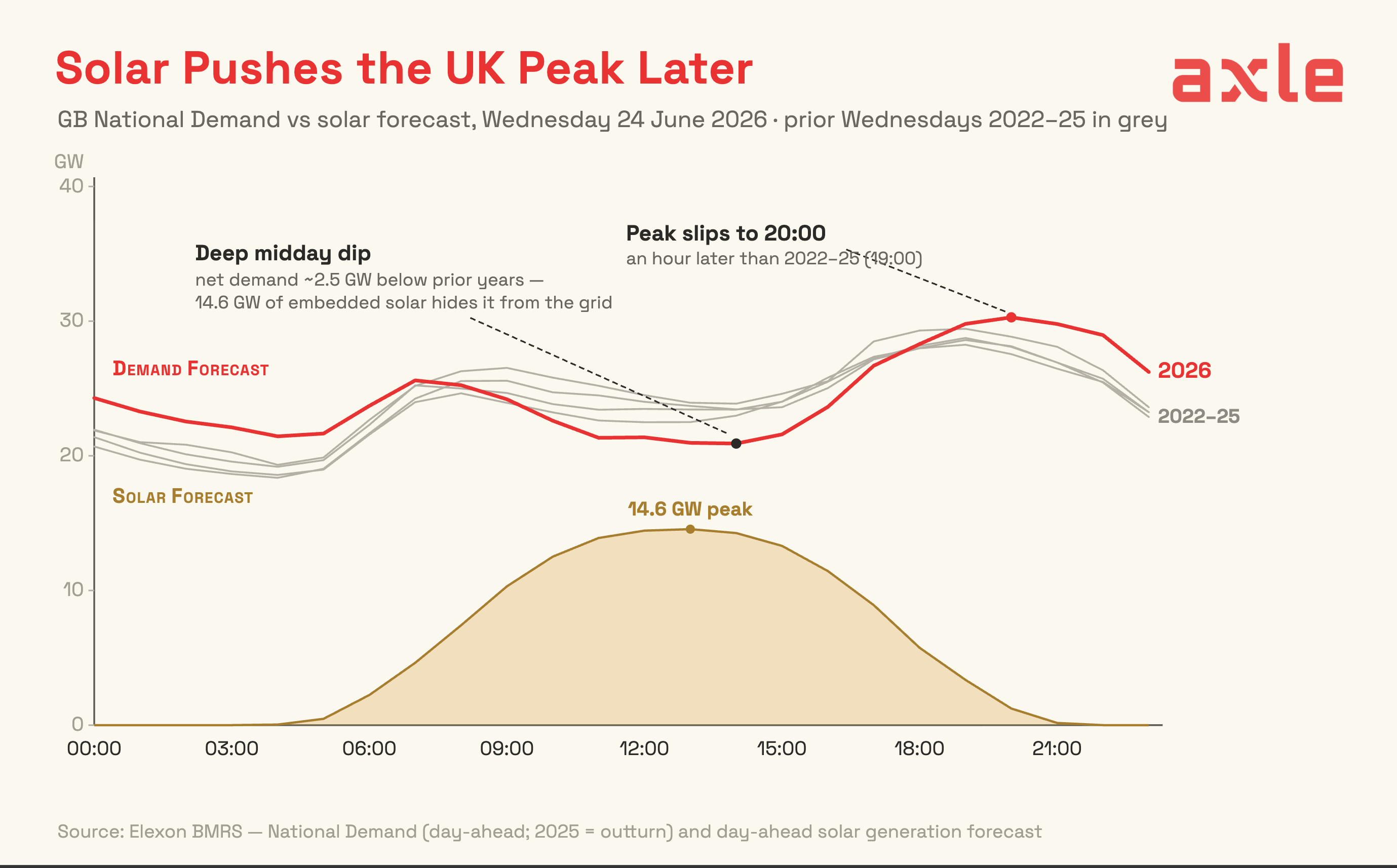
Evening demand is higher for June 24 2026 than for the equivalent day over the last 5 years. But the difference is relatively subtle; the peak is ~10% higher than the same day last year.
However, this story is mirrored nearly everywhere across Europe, particularly in France. Here differences are much more profound, because France gets much hotter than the UK, and they have more electric cooling.

This matters because GB and European power markets are increasingly coupled thanks to interconnection. These are the undersea cables that allow power to flow to and from the continent. Fluxes vary depending upon prices: high continental prices tend to pull power from GB generators, and vice versa. Changes in supply and demand on either side of the Channel influence prices across the continent. This trend will continue to increase through 2030.

However: although demand is higher than we’d expect at this time of year, it’s not objectively high. It’s still far lower than the regular Winter peaks. But the important thing from the system’s perspective is that we expected demand to be high in January, and we didn’t expect it to be high in June.

It's vacation time for power plants
Power plants require regular maintenance. June is a good time to do it. But not this June.
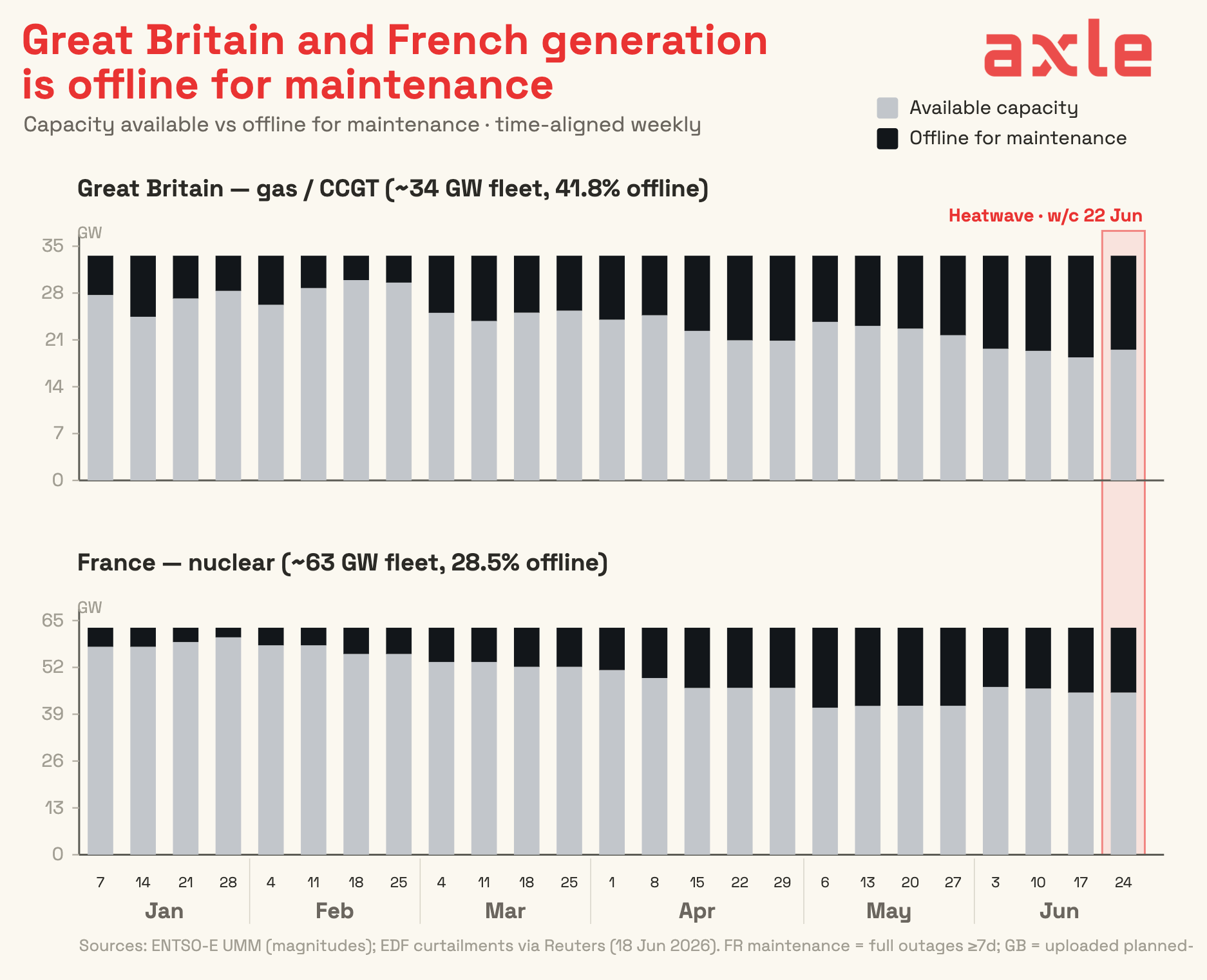
In the UK, almost 15 GW of our 34 GW of Combined Cycle Gas Turbines (the main form of gas power plant) are offline. That’s 42%!
And we’re not alone: EDF also takes advantage of the expected early Summer lull to service their nuclear power plants in France. They’ve got ~29% offline for maintenance. GB frequently benefits from cheap French nuclear over interconnectors to top up its energy system; not this June.
As climate change brings greater and greater unpredictability, we should expect this kind of mis-timed planned maintenance to become a bigger and bigger issue. Fortunately wind and solar don’t rely upon superheating steam, and require fewer prolonged maintenance periods.
In fact, soaring solar generation is one of the factors suppressing prices - the sharp rise in price around 7pm is linked to the sun going down, as Ember reported during a similar heatwave last year. We can see this in the demand profile for 24th June, which has a deep dip around 12 - this is embedded solar generation eroding demand before it hits the grid2.
French nuclear takes a hot bath 🥵
Nuclear power plants require a lot of water for cooling. If the water that they’re using is hotter to begin with, they can’t dump as much heat, and so they need to run at lower capacity.

EDF has announced reduced output at four reactors along the Garonne and Rhône rivers (Reuters), where temperatures are tickling the 40s. This accounts for roughly another 2GW of capacity reduction on top of the planned maintenance already occurring.
Conclusion
Thanks to the way prices are set in the electricity market, small shifts in demand can have a big effect upon price. Generators with long maintenance windows can’t react to unexpected changes in weather conditions, and so supply can be sluggish to react to changes in demand. This supply-inelasticity produces price spikes like the one we’ve seen on June 24th 2026.
Our power systems need more flexibility to respond to rapid changes. At Axle Energy, we provide flexibility through demand side response, shaping demand in households and businesses to limit peak demand and reduce strain on the grid. On June 24th 2026 we’ll be dispatching tens of thousands of batteries as part of the Axle VPP, reducing demand using solar energy stored from earlier in the day. That energy will flow to other households, powering air conditioning and cold showers.
If you fancy playing a role in keeping Britain cool and prices low, consider coming to work with us.
Footnotes
[1] We did see a big spike on 19th July 2022. Temperatures hit 40C and prices hit £418/MWh. This was peak energy crisis - the following day an import constraint resulted in unprecedented interconnector spend (NESO). 2022 still saw a winter-peaking day ahead price, on 12th December 2022.
[2] Solar generation becomes less efficient at high temperatures, but this effect is small relative to the impact of copious sunshine. Wind generation has also been low this week, but not unususally so
craig-woollaston

karl-bach

alex-pan

christopher-link

ohad-portnoy


Commencez
Discutons de la manière dont vous pouvez créer une proposition flexible de premier ordre avec Axle
