


Wind curtailment is a proxy battle for locational pricing
October 8, 2026

Previous Article
Next Article
This week, The Times published an article on the cost of curtailing wind power, their third article on the topic in the past few months, based on data from Octopus Energy.
The headline numbers are indeed large; £1.5B year-to-date, and rising.
But the headline is misleading; £1.28B of that £1.5B, or about 85%, has gone to paying gas turbines near cities to turn on, instead of paying wind turbines to turn off.
Constraint costs should be minimised, all else equal, but there's quite a bit under the hood. Let’s break it down.
The economics of wind
Wind and solar economics differ meaningfully from carbon power in 2 important ways:
- No marginal cost: the cost of a wind and solar farm is nearly all upfront; the marginal cost of producing an additional unit of power is effectively zero
- High covariance: within a (European-sized) country, the amount of solar or wind across the country goes up and down in unison
Together, this means that the more renewables we have, the more likely it is that we produce too much energy at a given time.
Is this a problem?
Not necessarily. If it’s cheap enough to build wind and solar farms, you could imagine a lowest-cost energy system driven by overbuilt renewables, where a wind farm operating at a low capacity factor is still more cost-efficient than alternatives like firing up a gas power plant.
This is what we’re starting to see in continental Europe; increased solar curtailment, where total generation at times exceeds total demand.
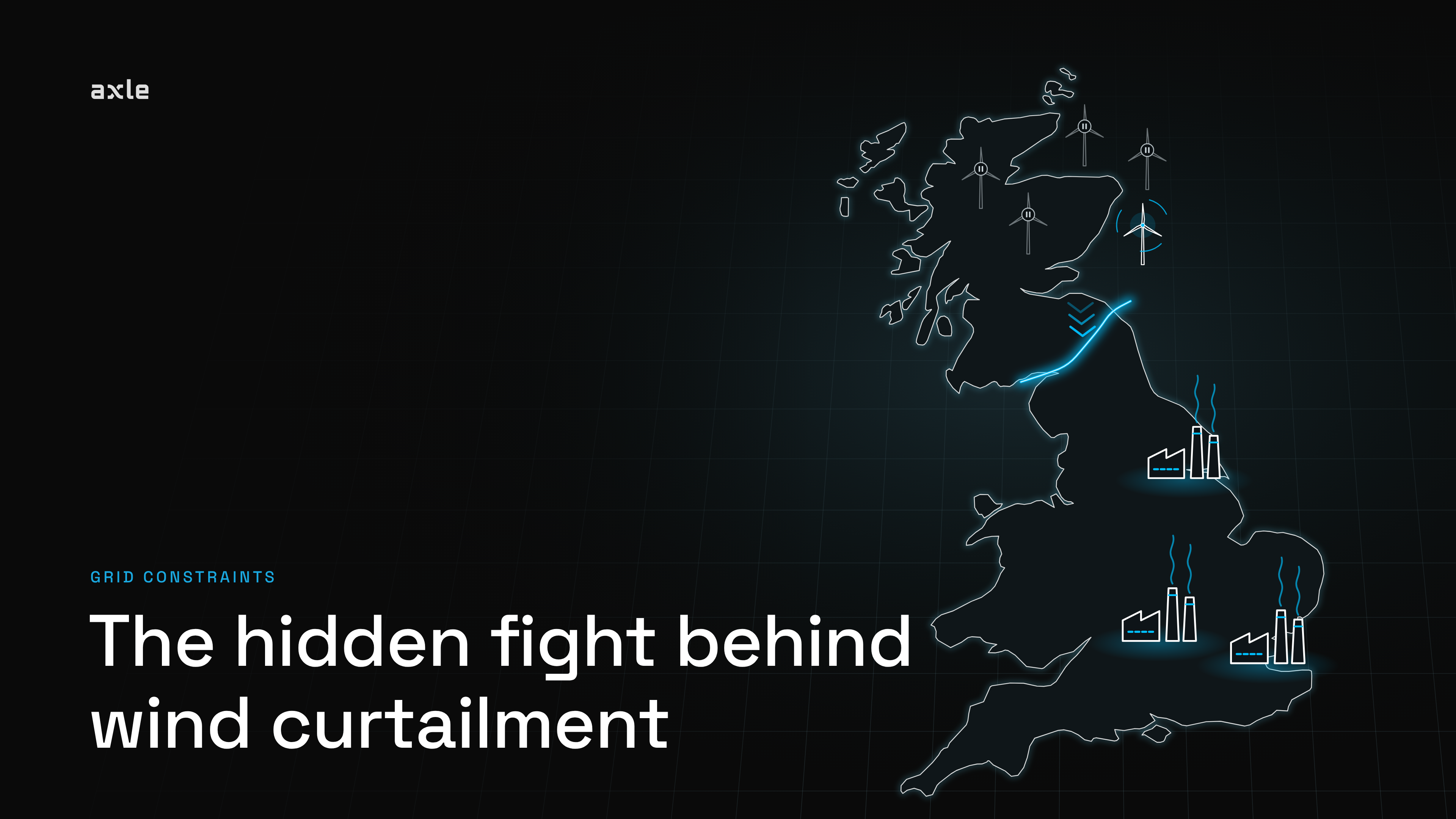
The UK situation is a bit different. Here, much of the wind generation is in Scotland, but most of the demand is in England. And the transmission capacity to bring that Scottish wind to English consumers is constrained, because generation has grown faster than network capacity. (Separating generation from transmission expansion was a deliberate policy decision, and likely the right one historically).
The obvious solution is to build more cables to increase that capacity. And hey, the UK is doing so; the Eastern Green Links are a series of 4 transmission lines from Scotland to England, coming online from 2029-2034, which should more than double the capacity across this constraint.
These cost a pretty penny, about £13B in total. They’re all offshore, which costs ~5x the on-land equivalent, but reduces community objections, permitting delays, and the like. Ofgem’s analysis suggests they’re good value-for-money.
We can also soak up the excess wind in Scotland (through batteries, EVs, industrial processes, etc.) and reduce demand in England when there isn’t much cheap generation available. This is part of what flexibility companies like Axle do.
So what’s the big deal?
Unsurprisingly for energy, this is a small fight within a larger battle.
Great Britain has one national market for wholesale electricity; that means that a MWh generated in northern Scotland gets paid the same as one generated in London. The wind curtailment issue highlights a shortcoming of that approach; wind developers want to build wherever it’s windiest, so it’s up to the central planners to approve & plan for the generation and transmission that’s in the best interest of the system.
An alternative is locational pricing; different prices in different parts of the country, which create a price signal to, say, build more generation close to consumer.
Economists love this, but most others don’t; it creates winners and losers, and would be a very large and disruptive (read: expensive) change to the structure of the energy market.
Last year, the government considered locational pricing, which opened up a pitched battle within industry. The government ruled against it. Supporters are using wind curtailment to continue fighting this battle, and in the process providing (misleading) ammunition for the 'net zero is bad' crowd.
As always, the truth hides beyond the headlines.
craig-woollaston

karl-bach

alex-pan

christopher-link

ohad-portnoy


Get started
Let's discuss how you can build a world-class flex proposition with Axle
